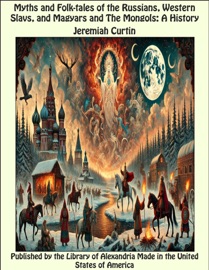
Myths and Folk-tales of the Russians, Western Slavs, and Magyars and The Mongols: A History
By Jeremiah Curtin
- Release Date: 2026-05-12
- Genre: Fairy Tales, Myths & Fables
Description
A FEW tens of years ago it was all-important to understand and explain the brotherhood and blood-bond of Aryan nations, and their relation to the Semitic race; to discover and set forth the meaning of that which in mental work, historic strivings, and spiritual ideals ties the historic nations to one another. At the present time this work is done, if not completely, at least measurably well, and a new work awaits us, to demonstrate that there is a higher and a mightier bond,—the relationship of created things with one another, and their inseverable connection with That which some men reverence as God, but which other men call the Unknowable, the Unseen.
This new work, which is the necessary continuation of the first, and which alone can give it completeness and significance, will be achieved when we have established the science of mythology.
Of course all that may be attempted in a volume like the present is to throw out a few hints, and to mention some of the uses of mythology as a science.
There is a large body of myths and folk-tales already published in Europe, and still a great number as yet uncollected. Many of these tales are of remarkable beauty. They are of deep interest both to young and old, and nowhere do they enjoy more delicate appreciation than among educated people in America and England. The delight in a beautiful and wonderful story is the very highest mental pleasure for a child, and great even for a grown man; but the explanation of it (if explanation there be) and the nature of its heroes (if that can be discovered) are dear to the mind of a mature person of culture. Much has been written touching the heroes of folk-tales, as well as the characters in Aryan mythology, but it appears to have produced small effect; for to most readers it seems unproven, and founded mainly on the views of each writer. This is the reason why the chief, almost the only, value found in folk-tales, as yet, is the story itself, with its simple beauty, incomparable grotesqueness, and marvellous adventures.
The great majority even of the least modified tales of Europe have mainly substituted heroes,—sons of kings, tsars, merchants, poor men, soldiers,—so that in most cases the birth, occupation, or name of the present hero gives no clew to the original hero of the tale; but incidents do. The incidents are often an indication of what kind of person the original hero must have been.
A few of the tales in this volume have preserved elemental heroes; and this is a fact of great value, for it points to a similarity with the American system of mythology.
We have in the present volume Raven,—not the common bird, but that elemental power which, after having been overcome, turned into the common raven of to-day, and flew off to the mountains; Whirlwind and South Wind are both heroes,—one as a leading, the other as an important secondary, character in two of the Russian stories. We have two brothers Wind, in “The Cuirassier and the Horned Princess,” in whom the personal character of Wind is well maintained. The steed, fire-eating and wise, of the Magyars, which appears also in Russian and other Slav tales, always mangy and miserable except in action, is a very significant character, whose real nature one may hope to demonstrate. But we have no tale in which it is clear who all the characters are; the modifying influences were too great and long-continued to permit that. Though myth-tales are, perhaps, more interesting for the majority of modern readers in their present form, they will not have their full interest for science till it is shown who most of the actors are under their disguises.
This is the nearest task of mythology.
There are masterpieces in literature filled with myths, inspired with myth conceptions of many kinds, simply colored by the life of the time and the nations among which these masterpieces were written and moulded to shape by artists, made strong from the spirit of great, simple people, as unknown to us as the nameless heroes who perished before Agamemnon. How much mythology is there in the Iliad and the Odyssey, in the Æneid, in the Divine Comedy of Dante, in the works of the other three great Italian poets? How much in Paradise Lost? How could “King Lear” and “Midsummer Night’s Dream,” or the “Idylls of the King” have been written without Keltic mythology? Many of these literary masterpieces have not merely myths in their composition as a sentence has words, but the earlier ones are enlarged or modified myth-tales of those periods, while the later ones are largely modelled on and inspired by the earlier.
The early chronicles of nations are as strikingly associated with mythology as are the masterpieces of literature. Omitting others, one case may be noted here,—that of the voluminous Gaelic chronicles and the so-called historical tales of Ireland, which, in the guise of history, give mythology, and preserve for coming investigators a whole buried Pantheon.
The service of the science of mythology will be great in connection with the myth-tales of nations, with literature, and with early history; but its weightiest service will be rendered in the domain of religion, for without mythology there can be no thorough understanding of any religion on earth, either in its inception or its growth.
But how is this science from which men may receive such service to be founded?
In one way alone: by obtaining from races outside of the Aryan and Semitic their myths, their beliefs, their view of the world; this done, the rest will follow as a result of intelligent labor. But the great battle is in the first part of the work, for the inherent difficulty of the task has been increased by Europeans, who have exterminated great numbers among the best primitive races, partially civilized or rather degraded others, and rendered the remainder distrustful and not easily approached on the subject of their myths and ethnic beliefs.
As to the collection of these myths and beliefs, the following may be stated:—
There is everywhere a sort of selvage of short tales and anecdotes, small information about ghosts and snakes, among all these races, which are easily obtained; and most Europeans seem to think that when they have collected some of these trivial things they have all that the given people possess. But they are greatly mistaken. All these people have something better. There was not a single stock of Indians in America which did not possess, in beautiful forms, the elements of an extensive literature, with a religion and philosophy which would have thrown light on many beginnings of Aryan and Semitic thought, a knowledge of which in so many cases is now lost to us, but which we hope to recover in time. The same may be said of other primitive races, still unbroken, unmodified; and though much has been lost, still enough remains to serve our purpose fully, if civilized men instead of slaying “savages,” directly and indirectly, will treat them as human beings, and not add to the labor of those workers who in the near future will surely endeavor, singly or in small groups, to study the chief primitive races of the earth, and win from them, not short insignificant odds and ends of information, but great masses of material; for the educated world may rest assured that these races possess in large volume some of the most beautiful productions of the human mind, and facts that are not merely of great, but of unique, value.
In the introduction to my volume, “Myths and Folk-lore of Ireland,” I endeavored to explain in brief what the myths of America are, especially the Creation-myths, referring only to those which I myself have collected. I stated that, “All myths have the same origin, and that all run parallel up to a certain point, which may be taken as the point to which the least developed peoples have risen” (page 27). I do not know any better way of illustrating this than to bring into evidence myths of the Morning-star. The Indians have a great many myths in which the Morning-star figures as the Light-bringer,—the same office as that indicated by the Latin word Lucifer; and here I may be permitted to present a short chapter of my personal experience with reference to that word and the Morning-star.
I remember well the feelings roused in my mind at mention or sight of the name Lucifer during the earlier years of my life. It stood for me as the name of a being stupendous, dreadful in moral deformity, lurid, hideous, and mighty. I remember also the surprise with which when I had grown somewhat older and begun to study Latin, I came upon the name in Virgil, where it means the Light-bringer, or Morning-star,—the herald of the sun. Many years after I had found the name in Virgil, I spent a night at the house of a friend in Milwaukee, Wisconsin, right at the shore of Lake Michigan. The night was clear but without a moon,—a night of stars, which is the most impressive of all nights, vast, brooding, majestic. At three o’clock in the morning I woke, and being near an uncurtained window, rose and looked out. Rather low in the east was the Morning-star, shining like silver, with a bluish tinge of steel. I looked towards the west; the great infinity was filled with the hosts of heaven, ranged behind this Morning-star. I saw at once the origin of the myth which grew to have such tremendous moral meaning, because the Morning-star was not in this case the usher of the day but the chieftain of night, the Prince of Darkness, the mortal enemy of the Lord of Light. I returned to bed knowing that the battle in heaven would soon begin. I rose when the sun was high next morning. All the world was bright, shining and active, gladsome and fresh, from the rays of the sun; the kingdom of light was established; but the Prince of Darkness and all his confederates had vanished, cast down from the sky, and to the endless eternity of God their places will know them no more in that night again. They are lost beyond hope or redemption, beyond penance or prayer.
I have in mind at this moment two Indian stories of the Morning-star,—one Modoc, the other Delaware. The Modoc story is very long, and contains much valuable matter; but the group of incidents that I wish to refer to here are the daily adventures and exploits of a personage who seems to be no other than the sky with the sun in it. This personage is destroyed every evening. He always gets into trouble, and is burned up; but in his back is a golden disk, which neither fire nor anything in the world can destroy. From this disk his body is reconstituted every morning; and all that is needed for the resurrection is the summons of the Morning-star, who calls out, “It is time to rise, old man; you have slept long enough.” Then the old man springs new again from his ashes through virtue of the immortal disk and the compelling word of the star.
Now, the Morning-star is the attendant spirit or “medicine” of the personage with the disk, and cannot escape the performance of his office; he has to work at it forever. So the old man cannot fail to rise every morning. As the golden disk is no other than the sun, the Morning-star of the Modocs is the same character as the Lucifer of the Latins.
The Delaware story, also a long one, has many grotesque and striking elements. I will tell it in a closely compressed form. The person who is the hero of this tale has a wife, who, while he is absent hunting, turns into a man-eater,—becomes a devouring agency with a mania to swallow all flesh, but has a special and craving mania to eat up her own husband first of all; so she runs to the woods to find him. Informed by a wise, talking dog, a species of brother of his, who had sprung out to anticipate the woman, the man rushes off southward, runs with all speed till he reaches a deep mighty river, where is an old man who makes a bridge by stretching his neck across the water. The hunted husband speaks kindly, and implores for means to cross or his wife will devour him. The old man lies down with his shoulder on one bank, stretches his neck, makes it flat like a horse’s neck, to give safe passage; soon his head is on the other bank, and the man walks over. The old bridge-maker promises to delay the woman, and then throw her into the river, where she will be eaten by monsters,—all save her stomach, in which her life resides; that will float down with the current, come to life, and the woman will be as well and furious as ever, unless the stomach is dragged out, cut to pieces, and burned.
The hunted man hastens, runs westward by the bank of the river, runs till he comes to two aunts who are witches. They promise to help him and kill the pursuer. Soon after, when the old man has shortened his neck and is sitting on his own side of the river, the wife comes up in hot pursuit, talks roughly, tries to hurry the old pontifex; but he will not hurry, waits, and then stretches his neck, putting the narrow side upward; it is no wider than the woman’s feet. She storms, but he says that being old he might break his neck were he to give the broad side as a path; she must walk on the narrow side, and carefully too. She begins to cross, but in the middle of the river grows restive and angry. The old man jerks his neck to one side; she falls to the water and is eaten right away, all save her stomach, which floats with the current. But the aunts, the two witches, are watching; they see and pull out the stomach, cut it up, and burn the life of that man-eater.
The man travels westward till he sees a young woman gathering branches for fuel. He speaks to her, is pleased; she is mild-eyed, kind-looking. He asks her to marry him; she says she is willing if he can live with her grandmother, who is very thick, very ugly, and malicious. He goes home with the young woman; they are married.
Soon after the marriage the old woman took her son-in-law to hunt on an island in a lake. They landed. She said, “Go down there,” pointing to a place; “I will drive the game.” He started, and when half way, looked back; the old woman was in the canoe paddling to the other shore. He called; she would not listen, and left him alone on the island. There was no escape. When the sun had gone down and darkness came, the water of the lake began to rise, and flooded the place. He selected the highest tree, and began to climb,—the water all the time rising; he climbed, and continued to climb. About three o’clock in the morning all the trees on the island, except that tree, were covered. Around on every side were great hungry savage-eyed creatures, rising with the water, waiting to eat the man. He looked, saw the Morning-star, and cried out: “When I was young the Morning-star appeared to me in a dream, and said that if ever I should be in distress he would save me.”
The star heard the call, turned to a small boy standing sentry at his door, and said, “Who is that shouting on the island?”
“That,” said the boy, “is the old woman’s son-in-law. She put him there. He says you appeared to him in a dream and promised to save him.”
“I did, and I will.” The Morning-star came forth from his house and called: “Let daylight come!”
Dawn came that moment; the water began to fall, and at sunrise the island was dry. The man was saved, came down, went to the landing-place, and hid in the bushes. Soon the old woman’s canoe struck the shore; the man heard her say: “Well, I suppose the larger bones of my son-in-law are under the tree. I must go and eat the marrow.” When she had gone far enough, he sprang into the canoe and paddled away. The old woman turned, saw the escape of her son-in-law, and cried: “Come back! I’ll play no more tricks.”
The man paddled to the other shore, and went to his wife. The old woman was alone, not able to escape. When darkness came, the lake began to rise. She climbed the highest tree, climbed till the water was nearing the top, and the hungry, terrible creatures were waiting to eat her. Then she called out towards the east: “When I was young the Morning-star appeared to me in a dream, and said he would help me out of distress.”