
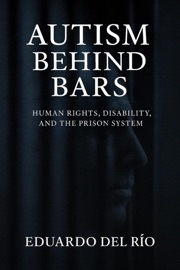
Autism Behind Bars
By Eduardo del Río
- Release Date: 2025-08-16
- Genre: Social Studies for Young Adults
Description
Prisons were never designed for difference. Inside their walls, routines are rigid, environments are harsh, and silence is enforced through punishment rather than understanding. For most, survival depends on adaptation. But what happens when adaptation is neurologically impossible? Autism Behind Bars reveals the hidden crisis of autistic men and women trapped within systems that were never built for their minds. This groundbreaking work is the first of its kind to weave medical science, human rights research, and lived testimony into a single narrative. With authority and compassion, Eduardo Del Río exposes the reality of autistic individuals who find themselves funneled into the criminal justice system—often undiagnosed, misinterpreted, or abandoned. Through a blend of case studies, international comparisons, and policy analysis, the book lays bare a system that mistakes difference for defiance, punishes sensory overload as disobedience, and isolates those who most need connection. Readers will encounter stories of young adults whose meltdowns were mistaken for aggression, of individuals coerced into crimes they did not fully understand, and of families fighting against an institution unwilling to listen. These stories are not isolated incidents—they are symptoms of a systemic failure. Research cited in these pages shows that between 4–10% of inmates may meet diagnostic criteria for autism spectrum disorder, yet the vast majority remain undiagnosed. This neglect has devastating consequences: vulnerability to exploitation, overrepresentation in solitary confinement, heightened risk of suicide, and long-term trauma that often worsens the very traits misunderstood at the time of arrest. What distinguishes Autism Behind Bars is its balance of the scientific and the human. Clinical explanations of autism spectrum disorder, sensory processing differences, and co-occurring conditions are presented clearly, but always alongside the lived experiences of those whose daily lives are shaped by them. Complex research is translated into accessible language, making the book useful for professionals while still resonating with families and advocates. Eduardo Del Río draws on a wide range of sources, from peer-reviewed medical studies to policy papers and global prison reform efforts. He situates the U.S. and Puerto Rico within a broader international landscape, comparing their systems with models from the United Kingdom, Norway, and Sweden. While other nations are beginning to pilot diversion programs, specialized prison units, and staff training initiatives, the American and Puerto Rican contexts lag behind—failing some of society’s most vulnerable citizens. This book is not only diagnostic; it is prescriptive. In later chapters, Del Río presents a path forward: early screening, diversion programs that redirect autistic individuals away from incarceration, training for prison staff, and prison architecture that takes sensory environments into account. These recommendations are grounded not only in research but in moral urgency. At stake is nothing less than the recognition of autistic people as full human beings whose dignity does not stop at the prison gate. Yet Autism Behind Bars is more than an academic contribution. It is a call to conscience. Through narrative vignettes, readers are invited into the intimate realities of life inside: the overwhelming echo of metal doors slamming, the unbearable brightness of fluorescent lights, the terror of solitary confinement, and the loneliness of being misunderstood at every turn. Each story asks a simple but profound question: can a society call itself just when it punishes individuals for the ways their brains are wired? For policymakers, the book provides evidence-based recommendations. For professionals in law, medicine, and psychology, it offers a resource grounded in both science and humanity. For families, it gives language to experiences long silenced.